The Energy Loyalty Tax: Why Staying Loyal Costs Aussie Small Businesses

Australian small businesses should review and potentially switch energy providers every 12 months, or whenever their contract approaches renewal. According to the Australian Energy Regulator (AER), small businesses on default electricity standing offers can save hundreds of dollars a year by switching to competitive market plans tracked through the Default Market Offer (DMO).
If you haven't reviewed your business energy plan in the last 12–24 months, you're almost certainly overpaying.
Key Takeaways
Review contracts annually: Audit your commercial energy rates every 12 months before introductory discount benefits expire.
Beware the loyalty tax: Long-term energy customers pay significantly more than new sign-ups for identical electricity supply.
Switch on rate rise notices: Treat formal rate increase notifications from your energy retailer as an immediate trigger to switch.
Leverage commercial terms: Small businesses can negotiate custom tariff structures, peak timing, and usage terms that residential customers cannot.
What Actually Is the Energy Loyalty Tax?
While it’s called a loyalty tax, it has nothing to do with the Australian Taxation Office (ATO). The loyalty tax, instead, is actually a market dynamic where long-term customers pay significantly more than new customers for the same energy.
As Dr Brendan French, Chief Executive Officer of Energy Consumers Australia, said, “The reality of the loyalty tax is perverse. The Australian Competition and Consumer Commission (ACCC) has found that households and small businesses who’ve stayed with a retailer for a couple of years are often paying hundreds of dollars more per year simply for their loyalty.”
How the Loyalty Tax Works Against You
Expired Discounts: Benefit terms and introductory percentage discounts typically last only 12 months. Once expired, your account defaults to the retailer's significantly higher standard reference price or DMO.
Market Changes: Retail electricity prices shift frequently due to wholesale market fluctuations, seasonal demands, and regulatory updates. If you do not actively adjust your contract, you miss out on price drops.
Lack of Negotiation Power: Unlike corporate enterprises with dedicated account managers, small-to-medium businesses (SMBs) rarely get auto-adjusted to cheaper tariffs without actively demanding a review or threatening to switch.
Complexity as a Barrier: Retailers intentionally use varied tariff structures, peak or off-peak timing, and dense billing jargon to create friction, betting that busy business owners will find comparison too time-consuming to act.
How Often Should You Switch Energy Providers in Australia?
You should review your energy contract every 6 to 12 months and switch providers whenever a better market rate is available or when your current contract benefits end. Here’s what we can recommend if you switch energy providers:
Every 6 Months: Perform a quick market scan to check if your current rates match newly advertised introductory plans.
At Month 11: Set an alert before your 12-month contract or discount period expires to negotiate a lower rate or select a new energy retailer.
Immediately After a Rate Rise Notice: Retailers are legally required to inform you of price increases. Treat any notice of a rate hike as an immediate trigger to shop around.
In Victoria, new rules from 1 July 2026 under the Essential Services Commission (ESC) mean retailers must move customers on plans older than four years to fairer rates, but this doesn't replace the need for smart energy management.
If being with the same provider is costing you money, Empire Power can compare every major energy provider in Australia to find the best commercial rate for EmpireOne members. We're not an energy retailer, but rather your savings partner.
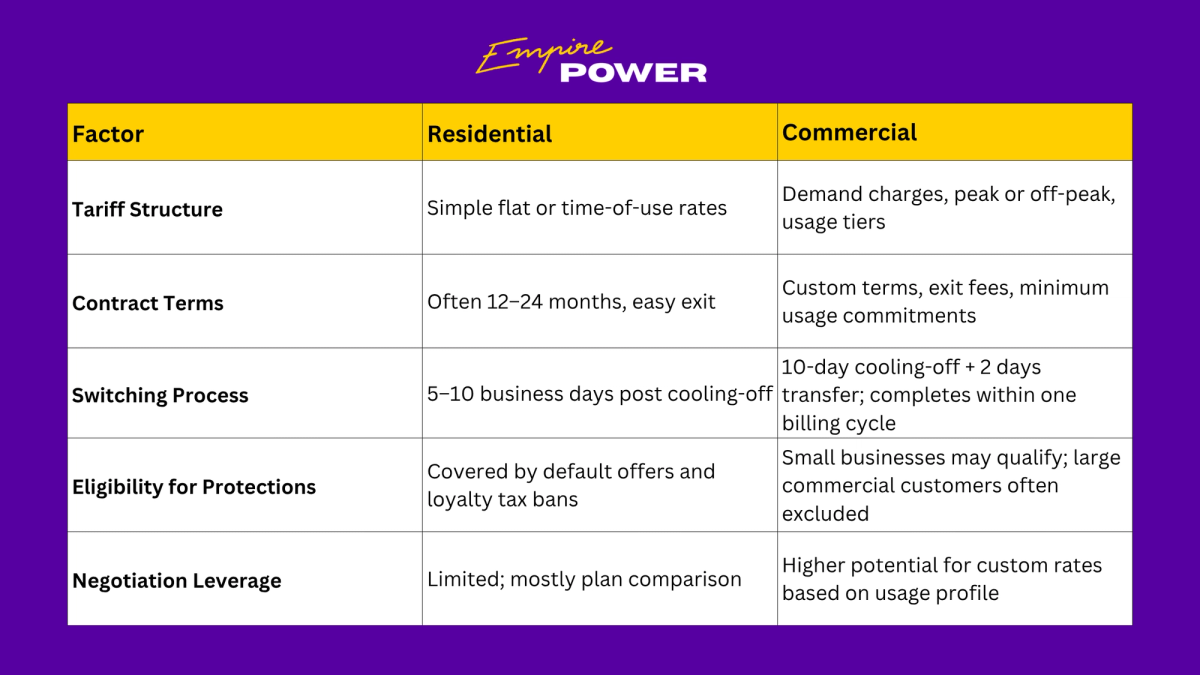
Commercial vs Residential Energy Switching: What's the Difference?
Frequently Asked Questions
Is a multi-policy discount worth it or a loyalty trap?
Multi-policy discounts (bundling electricity, gas, or broadband) are often a loyalty trap. While they offer convenience and a minor discount, individual standalone providers usually offer far cheaper base rates for each utility service. Always compare the total standalone cost against the bundled price.
Will switching providers affect my credit score?
No, switching energy providers will not negatively affect your credit score under normal circumstances. Retailers perform a basic soft credit check when opening a new commercial or residential account, but this does not impact your credit history as long as your previous bills were paid on time.
How long after an energy rate rise can I switch?
You can switch energy providers immediately after receiving a rate rise notification. In Australia, energy retailers must give advance notice of price increases, and most standard residential and small business contracts allow you to leave without exit fees when rates are adjusted upward.
Break Free From the Energy Loyalty Tax Trap
You deserve to be rewarded for your loyalty without quietly getting charged more for it. It may be inevitable, but you have a choice.
If you want to break free from the loyalty tax trap, Empire Power can review your current usage and rates, find the most cost-effective commercial plans, show you your potential savings, and if you're happy, we can manage the switch for you.
Create an account and upload your latest energy bill today!
Related Reading:
Posted by
