How to Cancel Automatic Energy Contract Renewals for Australian SMBs

Stopping an Australian small business energy contract from auto-renewing requires a simple administrative action: notifying your retailer or switching providers at least 20 business days before your benefit period expires.
When plans roll over automatically, retailers often transition businesses onto expensive standing offers.
While default prices have been historically high, the Australian Energy Regulator’s (AER) finalised 2026–27 Default Market Offer (DMO) determination brings welcome relief: default prices for small businesses have decreased by up to 20.9% in New South Wales, 14.0% in South East Queensland, and 12.1% in South Australia. Victorian small businesses should similarly audit the latest Victorian Default Offer (VDO) adjustments to maximise their savings.
However, even with these regulated drops, actively switching to a competitive market offer will still yield significantly lower rates than staying on a default plan.
Key Takeaways from Empire Power
Mark your calendar: Set a reminder 20 business days before your energy contract expires to review your options and prevent automatic rollovers.
Avoid the loyalty tax trap: Failing to switch or renegotiate can push your business onto default rates that are up to 30% higher than the market's best competitive offers.
No Lock-Ins: Most small business energy plans in Australia are month-to-month with zero lock-in exit fees, meaning you can walk away at any time.
What Is an Automatic Energy Contract Renewal?
An automatic energy contract renewal occurs when a business's fixed-term energy agreement or discounted benefit period expires, and the retailer automatically transitions the account onto a rollover plan to ensure uninterrupted power supply.
Auto-renewal provisions often alter your pricing structure, shorten your term, or introduce less favourable conditions. To protect your small- or medium-sized business (SMB) from unwanted auto-renewals, you should:
Carefully read your upcoming renewal notice.
Flag the official cancellation deadline.
Compare the renewed rates against current market options before that deadline passes.
Will Rates Increase When an Energy Contract Auto-Renews?
Rates can increase when an energy contract auto-renews, but it depends entirely on the terms of your agreement and your retailer’s renewal offer.
When your active contract or benefit period expires, any negotiated discounts, credits, or fixed-rate guarantees disappear. Unless you actively intervene, your energy retailer will automatically roll your account onto their standard default rate, historically referred to as a standing offer.
Market Offers vs. Auto-Renewed Default Plans
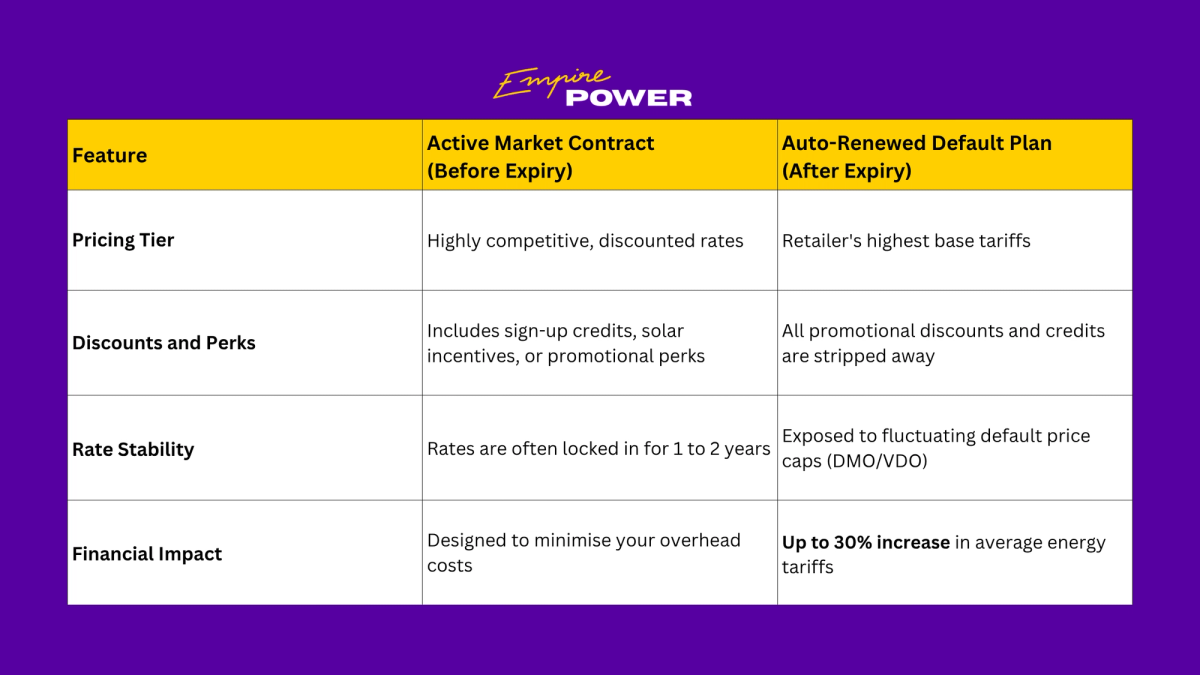
The AER explicitly warns that businesses on default contracts pay significantly more than those on active, negotiated market offers. Failing to negotiate new terms essentially subjects your business to a loyalty tax that quietly inflates your monthly operating expenses.
How to Stop Your Energy Plan from Auto-Renewing
1. Track Your Benefit Change or End-of-Plan Notice
Retailers in Australia are legally required to notify you before your energy contract, benefit period, or pricing structure changes.
According to National Energy Retail Rules, this document, officially called a Benefit Change Notice, must be sent to your business at least 20 business days before the change takes effect. The notice details when your current rates end, what your new rates will be, and your options moving forward.
Never ignore these letters or emails. Mark the expiration date on your business calendar immediately so you can begin sourcing alternative offers well before the rollover date.
2. Check Your Contract for Exit Fees
You must review your current energy contract terms to determine if there are any financial penalties for terminating the agreement.
For most small business customers (those consuming under 100 MWh of electricity per year), modern Australian energy regulations heavily restrict or completely ban exit fees on standard market contracts.
Knowing your contract terms allows you to time your switch without paying a single cent in avoidable penalties.
3. Compare the Market and Negotiate Terms
You should use your pending contract expiration as leverage to negotiate more favourable energy terms.
Do not accept the first renewal offer your current provider sends you. Take your recent bills, calculate your peak and off-peak usage, and request quotes from multiple competing retailers.
Once you have a lower offer in hand, you can contact your existing supplier's retention department to see if they will match or beat the competitor's rate.
4. Switch Providers (No Disconnection Required)
You can switch providers without disconnecting your electricity or gas supply. In most cases, the new retailer handles the transfer while the physical supply stays on through the same network, so the change is administrative rather than operational.
This makes switching a practical option if your current retailer will not improve the renewal offer or if the renewed rate is too high. The key is to move before the old contract rolls into a less favourable term.
If you want a simpler way to compare options, Empire Power can help review your current plan, find a better-fit energy solution, and manage the switch for you.
Frequently Asked Questions
Are energy plans in Australia lock-in or month-to-month?
Most small business energy plans in Australia are technically ongoing, month-to-month arrangements without lock-in contracts. While the benefit period (your discount rate) is usually fixed for 12 or 24 months, you are generally free to switch providers at any time without penalty.
Will I switch to the Default Market Offer (DMO) or Victorian Default Offer (VDO) when my plan ends?
If your fixed-term contract ends and you take no action, your retailer will typically transition you to a standard standing offer, which is capped at the regulated safety-net price: the DMO in NSW, QLD, and SA or the VDO in Victoria.
While these protect you from extreme price gouging, they are still significantly more expensive than competitive market offers.
What is the cooling-off period if I switch?
Small business energy customers in Australia are entitled to a standard 10-business-day cooling-off period when signing a new market retail contract. During this window, you can cancel the new contract for any reason without incurring penalties or fees.
Stop Overpaying for Energy with Empire Power
Automatic renewals can quietly push Australian SMBs onto weaker energy terms if they miss the notice window. If you want to avoid overpaying, upload your latest energy bill and Empire Power can compare it against a better business energy offer before your plan rolls over.
Posted by
