How Automated Energy Switching Saves Aussie SMEs Time and Money

Automated energy switching helps small and medium-sized enterprises (SMEs) compare available plans, monitor pricing changes, and move to a better-fit energy contract with less manual administration.
Historically, businesses in Australia have lost thousands of dollars annually to the loyalty tax, where energy providers quietly move out-of-contract customers onto more expensive default tariffs. This can happen when a contract expires, and the business does not actively negotiate a new plan or switch retailers.
Key Takeaways
Consolidate multi-site power bills into one dashboard to cut administrative accounting workload.
Track site-by-site power usage continuously to eliminate energy waste and lower costs.
Set and forget your energy strategy with automated switching that locks in lower rates.
57% of Leaders in Australia Fear Falling Behind on Energy
More than half of business leaders in Australia recognise that they may fall behind if they do not adopt smarter energy technology and operational systems. According to the Schneider Electric Australia Energy Tech Pulse 2026, 57% of leaders agree that inaction on the energy transition puts organisations at risk of losing market share.
This number reflects how businesses are responding to changing energy costs, efficiency expectations, technology adoption, and long-term competitiveness.
What is Energy Automation in Businesses?
Energy automation in businesses refers to the use of smart technology, sensors, and software to automatically monitor, control, and optimise how energy is generated, distributed, and consumed across facilities and buildings without constant manual input.
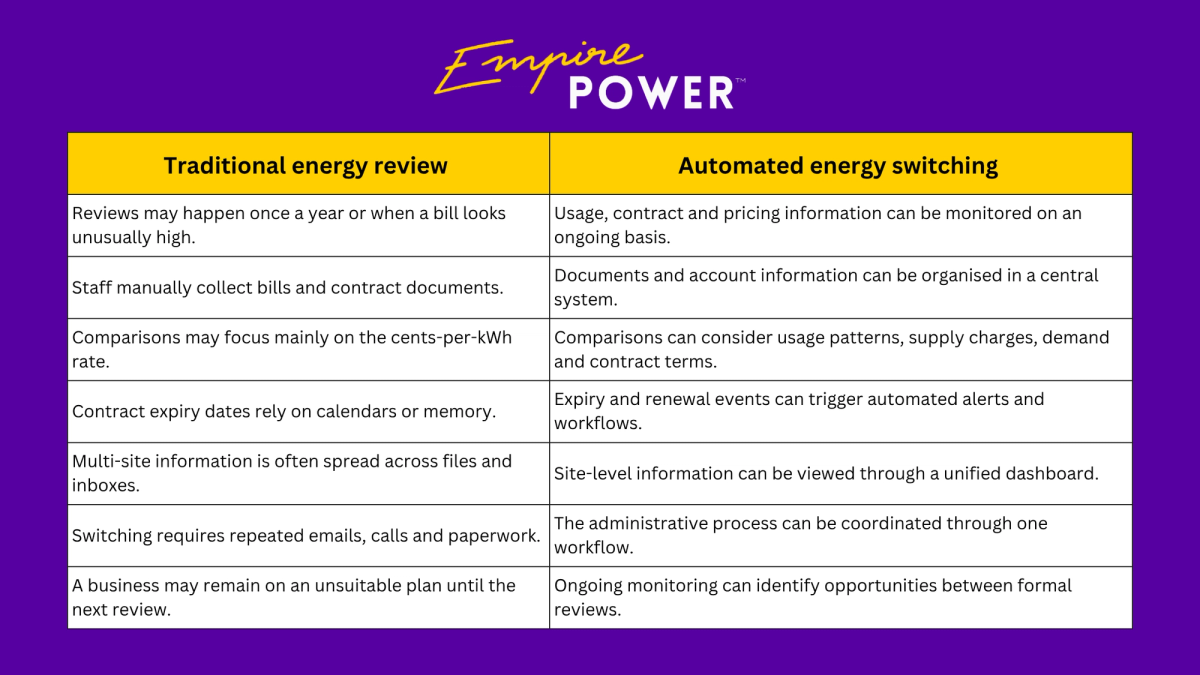
How Automated Switching Compares to Traditional Methods
What Makes Empire Power’s Energy Management Ecosystem Different?
Traditional energy brokers and review sites only evaluate your rates once a year or recommend single-switch options that eventually drift back up to standing offer prices.
Empire Power operates as a complete energy management ecosystem where you can set and forget your energy strategy. The system consolidates all your power bills into a single platform, tracks total consumption across multiple sites in one place, and continuously secures competitive rates.
Here’s what makes us different from other switching services:
Advanced Comparison Engine
The system processes your historic smart meter consumption data against every active market offer across Australian retailers, identifying precise cost-saving opportunities specific to your operational hours.
Automated Switching
Once optimal savings are detected, we manage the transition between retailers seamlessly, eliminating double handling, phone calls, and contract paperwork.
Unified Dashboard for All Sites
Instead of juggling multiple retailer accounts across different locations, business owners access a single view of total power consumption, site-by-site trends, and consolidated billing statements.
Ongoing Rate Monitoring
The platform monitors your rates continuously after you sign up. If a retailer increases prices or a lower rate enters the market, the ecosystem alerts you or switches your plan to maintain maximum savings.
Frequently Asked Questions
Am I on the wrong electricity tariff for my business?
You may be on an unsuitable tariff if your operating model has shifted since signing your energy plan. For example, if your business runs primarily during daytime hours, staying in a standard flat rate instead of a solar-matched or off-peak Time-of-Use tariff means paying higher rates for daytime energy. Comparing your usage logs against available tariff structures can highlight potential savings.
Are metering fees negotiable or fixed?
Metering fees are generally fixed and non-negotiable for residential and small business customers, but they can vary depending on your energy provider, location, and the specific service required.
Why did my bill jump this quarter with the same kWh?
Your bill jumped due to rate increases, daily supply charge adjustments, or peak demand threshold penalties. Retailers regularly update energy tariffs on July 1st annually.
If your fixed contract expired mid-year, your rate per kWh and daily supply charge likely drifted upward to standard standing offer pricing. Additionally, exceeding seasonal peak demand allowances can trigger higher network capacity tariffs.
Start Eliminating Energy Confusion
Automated energy switching helps Australian SMEs move from occasional, manual comparisons to continuous energy management.
With Empire Power’s automated energy ecosystem, you can consolidate your power bills, monitor usage across all your sites, and ensure your business stays on competitive rates permanently.
Create a free account and upload your latest energy bill today to see how much time and money automated switching can save your business.
Disclaimer: The information provided in this article is general in nature and intended for informational purposes only. Energy plan availability, rates, and potential savings vary based on business location, usage patterns, meter types, and individual retailer contract terms. Uploading a bill or creating an account provides a tailored analysis specific to your business.
Related Reading:
Posted by
